Saturday, 13 June 2020

A Guernsey project in Sheringham Museum, using my long knitting needles!


June 2020

I had a lovely bit of news from a good customer in Eastern England, the region we know as East Anglia, comprising mostly Norfolk and Suffolk, recently famous for its fishing fleet.

The Northfolk.org project was the brainchild of Martin Warren, ex-curator of the Cromer Museum. Martin is centered on Sheringham Museum and the website is the result of over 20 years of his research featuring the Museum’s large collection of ganseys and historical photos of old fisherman wearing ganseys.

He now has the support of many knitters and my customer has written: “Last year I was invited to a meeting of the Textile Group at Sheringham Museum and became involved in the Gansey project. A group of ladies knit swatches and samplers from charts compiled by Martin Warren from photographs and original ganseys in the Sheringham Museum and Cromer Museum collections. We are trying to replicate the fine work of the Sheringham gansey knitters.”

The various designs are beautifully catalogued in very easy-to-access pages showing dozens of photos of old fishermen and their ganseys. Each photo has its matching swatch, recently knitted, for modern knitters to access, and it is these swatches which the Textile Group knits regularly.


Belcher Johnson's herringbone and hailstones gansey and its matching chart

To see these beautiful designs, go to www.northfolk.org and lose yourself in the pages of ganseys. Val Smith has kindly mentioned me and my Youtube videos on one of the pages, and writes about the local knitting shields (elsewhere known as knitting sticks or sheaths). The shields are designed with one central hole drilled into a wooden core which snuggly fits just one size of needle. If you want to knit with a variety of sizes, you should try a knitting belt – and I sell these on my Etsy shop.
o – o – o - o

One of my most successful patterns has been a small child size guernsey pattern which I created nearly ten years ago. I made it for my grandson who was two years old at the time, and my grand-daughter modelled it. She was three years older, demonstrating that a guernsey will accommodate a range of ages, as its constructions lends itself to stretching to fit as the years pass. The pattern will fit children from 2 to 5 or 6 years of age. For a taller child, extend the sleeve and body lengths.
The best yarn for a guernsey is a 5-ply wool, spun with a worsted method. In the UK, worsted is not a thickness of wool but a method of spinning. The fibres of the wool fleece are laid out parallel in a horizontal sheet, all the kinks and twist removed. When this is spun it creates a very strong dense yarn with no ‘fluff’ or ‘halo’. This yarn wears very well, because it does not pill or pull out. In fact, over time it gains a sheen and polish which is very attractive and adds to its longevity, added to the fact that the yarn is dense and traditionally knitted at a tight gauge which displays the textured designs of the guernsey to advantage.

A genuine Guernsey (gansey or knit frock), knitted to the traditional design, has no front or back. Both are identical, so when it is worn it will be rotated to back and front and therefore its sleeves and cuffs last so much longer before they wear out. After many years, as the sleeves eventually wear out, and because they were knitted downwards towards the cuff, it is easy to cut off the worn out section and re-knit them, thus giving the garment a new lease of life. Similarly, if the neck wears, rip the rib out and re-knit that also. A child’s guernsey should last long enough to pass through several children or to give to the next generation.

If you want to have a go at knitting a guernsey, do it traditionally round and round with no seams on 4 or 5 dpn needles or a circular needle. Britain produces some first-rate guernsey wools (no man-made fibres!) in a large range of lovely colours, traditional blues, greys and navies, as well as more feminine colours such as pink and pale green. The most economical way to purchase is to buy a couple of cones, saving so many ends to weave in, but entailing carting a large cone around with you!

My Etsy shops sells the long double pointed (dpn) knitting needles which speed up the knitting of guernseys, both in 14 inch and 9 inch (35 cm and 13 cm) sizes from 1.5 mm to 5 mm (US 00 to US 8) (old UK 16 to 6).
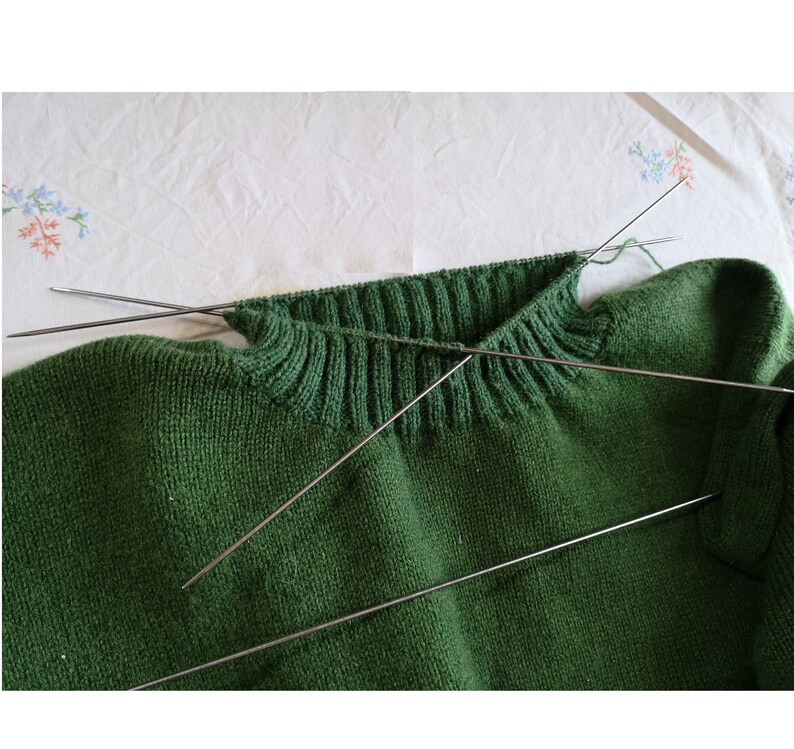
 There are some lovely books by such old-time experts as Michael Pearson, Gladys Thomson and Mary Wright, as well as more modern works by too many authors to mention, which will guide you on your way.

o – o – o - o


Thursday, 4 April 2019

Shetland Knitters Really Did Knit 200 Stitches a Minute!

I have spent many weeks and months researching the old knitters' reputed rapid speed of knitting.

A vintage film made in the early 1930s in Shetland, Scotland, showed aspects of lives which would not have changed for a couple of generations. This is many years before oil was discovered in Shetland and the old ways of life were to change for ever.

A while ago, this old black and white film was shown on British TV under the title 'Visit the Crofters' by the British company 'Talking Pictures' which discovers old and often unknown films from the archives of the famous old British film studies such as Pinewood. I watched it quite by chance one morning, and the lovely people at Talking Pictures have given me permission to analyse their film to study the old methods of knitting. The whole film also shows crofters rounding their sheep up off the hills, plucking - rooing - them, fishing for herring and making baskets. The film had a tourism-type commentary and some background music, but these added nothing to the subject of knitting.

Thank you, TalkingPicturesTV!

I have permission from the British TV Channel 'Talking Pictures' to work on their film, and here is the result. Thank you 'Talking Pictures'!

There have been stories of the phenominal speed that the old knitters could reach, and just as many suggestions that these stories were fictions - How could anyone possibly knit up to 200 sts per minute! The fastest knitters in the world of the 21st century cannot exceed 100 sts a minute. But these stories came from researchers not known for exaggeration.


Mary Wright in her book 'Cornish Guernseys & Knit Frocks' said:
'Freed from the necessity [by using a knitting stick] to hold the working needle, the knitter could use the fingers of the right hand as a shuttle to move the stitches from the left-hand needle. This greatly increased the speed of knitting and by a rhythmical motion of arms and body, the knitter would strike the loops 'faster than the eye could see'. Experienced knitters achieved very high speeds of about 200 stitches a minute.
 ' "Granny's fingers moved so fast, you couldn't see them" Mrs Edmunds of St Blazey"  '

Marie Hartley and Joan Ingleby wrote a definitive book 'The Old Hand-Knitters of the Dales' in about 1949, on professional knitting in Yorkshire (published 1952) and this described the knitting techniques practiced. 
"Mrs Crabtree remembers that her mother could knit a jersey or frock, as they were called (US: sweater) in a day and was paid a shilling for it."
If you go to Youtube you will see a video I published a few weeks ago summarising my research on this topic, and you will be able to see extracts from that "Talking Pictures" silent film on the knitters of Shetland. The fingers of the knitters are a blur, but the knitters are indeed working at 2 stitches per second and one of them considerably faster.

So the stories were NOT fiction! you will see from the silent conversation of the two ladies in the middle that this film is shown at real time speed. 

The film is mono-colour and very low resolution. The light is poor for the indoor scenes, so examining the film was not easy.
I slowed down the film to one-eighth of its original speed to see the individual hand movements of each stitch.

I could see how each stitch is formed: the wool is held in the left hand, and the working needle in the right. This is not the same as continental knitting as currently practiced, there is no change in the needle angles, and no twist in the actions of the hands. No hooking of the yarn. This is a very relaxed style. 

First the right hand needle is swung into the first loop on the left hand needle. The right hand needle is moved right-wards and the stitch is formed by the index finger of the left hand wrapping the yarn around the end  of the right hand needle. This was quite a difficult movement the first time I tried it and it took quite a few minutes to get my finger to work as I wanted! (I can now appreciate how difficult it is for a new learner of knitting!) It is the mirror image of the index finger movement practiced by many right-hand knitters. Immediately the needle is swung back leftwards under the left needle (it now contains its new loop) and a big swing right-wards pulls the old stitch off the left-needle. This big swing has another function too - it pulls just sufficient wool off the ball to feed the next stitch; to snug up the previous new stitch and ensure an even tension (gauge); and of course, prepare for the following stitch.

The right-hand needle now completes its swing back leftwards and immediately enter the next loop ready to form a new stitch.  All the while, the left hand has barely moved and the right hand has not moved its angle.

The action of the right needle is rather like a figure of eight. The knitter is giving a sympathetic sway to ease the needle's swing - is this the swaving, the sympathetic movement, often referred to by the old writers (including Mary Wright), said to be essential to maintain the speed?

The knitters could knit while walking, then the ball of wool is pushed into a pocket or tied to the waist by a little hook, to give an easy 'pull'. The yarn is pulled out from the centre of course to avoid the ball spinning into a tangle.


One knitter is making a narrow band of lace. She has tied her work to her belt to give tension, allowing the old row stitches to be stretched out and therefore easier to enter. The string is moved and adjusted every few rows to maintain the firm tension.

Interestingly, all these knitters are using pairs of needles with knobs. Not a single knitting stick between them!

I timed the knitters by slowing the film down to one-eighth speed! The fastest knitter was knitting at a phenominal 14 sts in around three seconds – that is a rate of 280 stitches per minute.

This gave me food for thought. It has revealed a skill and technique that just about every knitter thought had died out without being recorded. Incidentally, I have discovered another couple of films showing the same fast knitting but as yet I do not have permission to publish them.

To join my newsletter group please go to my website woollywoodlanders.co.uk and email me from the top of any page, and receive a free knitting pattern from my site.


(Unfortunately, in the introduction I appear to be gagged!!) To see all this for yourself watch my video - to be found by its title: 

Shetland Knitters Really Did Knit 200 Stitches a Minute!