

Tuesday, 3 May 2022
Vintage Rosebud Twin Dolls and their knitted clothes
I was delighted recently when the British woman’s magazine Women’s Weekly gave me permission to access the doll knitting patterns of the 1950s, to update them for modern knitters and publish in a new format. I am now scanning in all those lovely old patterns, giving the photos improved resolution and updating the needle sizes and knitting yarns for a new knitting public.
The 1950s decade was an era of Elegance, Neatness and Well-Dressed Dolls. I was 8 years old when these patterns were first introduced and they were an immediate success. Little girls at school collected the patterns which were introduced fortnightly, and we learned to knit to give our little dolls outfits which were a reflection of the clothes we were wearing ourselves. In the 50s, when rationing was still around, school uniforms for the under-11s did not exist in state Primary Schools. Most of us had at most just two or three outfits so these little designs let us give our dolls lots of colourful clothes made from those little balls of wool left over from our mothers’ projects.
I have huge admiration for the un-named designers and photographers who gave my own generation of little girls such a lot of fun.
We took our dolls to school and admired each others’ wardrobes! I lived in Whitefield, Manchester at the time. There was a local mum who always had an admiring crowd of small girls on the pavement outside her window watching her sew little outfits by eye for these dolls on her treadle sewing machine; and waited patiently until she was ready to hand them out to us all, quite free. I asked her once why she did not tie knots on the end of each seam (as I had been taught to do by my own mother) and she patiently showed me how to run backwards and forwards a couple of times at each end of a seam. I ran home to tell my own mother and Mum never tied any more tedious knots!
I have a great many of these patterns, and have begun the huge task of recreating the six-and-a-half-inch doll designs into four or five collections. Then will follow the seven-and-a-half-inch dolls …
 “Our Twins in Fair-isle” from the 1st Collection


Monday, 21 March 2022
Striped Guernseys of the 19th Century
When I was small, children's comics would feature burglars wearing striped jerseys with masks over their eyes. Apparently, back in early Victorian times, an infamous crime was committed as reported from an historical source by Penelope Hemingway in her Knitting Genie blog:
"DARING BURGLARY … It appears that the house was forcibly entered by three men, armed with pistols and long pointed knives; one of the men was very broad set, dressed in a Guernsey frock, with stripes across the body… the other two were similarly dressed….”
Since that time burglars are often shown as wearing striped guernseys. There is a theory that burglars chose these garments as they allowed them to run faster than the chasing policemen who would have been wearing tailored suits; or was it just that in those days working people only had one set of clothes and guernseys were the working clothes of many labouring men!
 I also have been unable to find any mention of an actual striped guernsey in any collection or museum. Maybe no-one thought to save one for later knitters to view, especially as they would only have been discarded when in a badly worn out condition, but I have found photos of such guernseys. When the first formal football clubs were formed 150 years ago, footballers played in their own sports clothes, it was soon realised that it was difficult for both the sportsmen and the spectators to distinguish between the two teams. So Clubs invented themselves uniforms which the players then devised for themselves.
Here is a photo of the famous Queens Park Rangers team of the 1870s, one or two wear shirts, and others have knitted guernseys - see far left!
I also have been unable to find any mention of an actual striped guernsey in any collection or museum. Maybe no-one thought to save one for later knitters to view, especially as they would only have been discarded when in a badly worn out condition, but I have found photos of such guernseys. When the first formal football clubs were formed 150 years ago, footballers played in their own sports clothes, it was soon realised that it was difficult for both the sportsmen and the spectators to distinguish between the two teams. So Clubs invented themselves uniforms which the players then devised for themselves.
Here is a photo of the famous Queens Park Rangers team of the 1870s, one or two wear shirts, and others have knitted guernseys - see far left!
 Another famous early club was Sheffield Wednesday and here is their 1878 strip which includes a few hand-knitted striped guernseys:
 Look at the drape, the varying stripe arrangements at the shoulders of the two photos. The treatment of neck fronts, shoulder buttons and some disparity in the width of the stripes indicate a hand-made non-standard guernsey. It wasn't long before companies such as Bukta were formed to machine knit these uniforms. Incidentally the knitted form of kit retained its popularity in rugby and football, albeit a more modern and small guage knit, perhaps because knitted fabric is more forgiving of rough handling than woven fabric.
I am indebted for much of the above detail to David Moor of Historical Football Kits who would appreciate any old football kit information that you can pass on. His pages also indicate that many football clubs played using recognisable modern rugby rules, while sometimes teams would favour a game we would recognise nowadays as soccer. It was many years before these games were standardised. David wishes me to state that the photos are not his own property.
Look at the drape, the varying stripe arrangements at the shoulders of the two photos. The treatment of neck fronts, shoulder buttons and some disparity in the width of the stripes indicate a hand-made non-standard guernsey. It wasn't long before companies such as Bukta were formed to machine knit these uniforms. Incidentally the knitted form of kit retained its popularity in rugby and football, albeit a more modern and small guage knit, perhaps because knitted fabric is more forgiving of rough handling than woven fabric.
I am indebted for much of the above detail to David Moor of Historical Football Kits who would appreciate any old football kit information that you can pass on. His pages also indicate that many football clubs played using recognisable modern rugby rules, while sometimes teams would favour a game we would recognise nowadays as soccer. It was many years before these games were standardised. David wishes me to state that the photos are not his own property.
Saturday, 24 July 2021
Do You Work a Seam Stitch in Your Knitting?
Why a seam stitch?
When I knit a guernsey (gansey) I always incorporate seam stitches. These are columns of purl or garter stitches, running down each side of the garment as if they were a seam. Apart from being a tradition it has more than a couple of practical uses.
If you use garter stitch for the 'seam' then each purl 'bump' signifies 2 rows and that makes counting rows much easier; anyone who has tried to count rows up stocking stitch knows how easy it is to lose your place as your eye loses concentration. With garter stitch then it is easy to keep your place with a thumb nail when you blink.
As you reach the beginning of the gusset, the start of the patterns or the sleeve position, the artificial seam line saves lots of counting stitches again to find the exact dividing line of the front and back panels;.the 'seam' then divides and splays outwards to follow the widening gusset edges, only to
come together when the gusset is narrowed back to the original 'seam'
partway down the sleeve.
Sometimes the 'seam' is more decorative than just a single purl stitch column. I have seen pretty little textured patterns, over 2 or 3 stitches, these also help to make the plain stocking stitch area a little more interesting and hide any looseness at the changeover of the needles. The seam also presents a useful position for starting a new ball of yarn.
I have been reading very old knitting primers (for schools to teach knitting), dating from the mid-19th century, and the instructions (recipes!) for knitting stockings invariably include the same artificial seam. This seam may hark back to the construction of stockings from fabrics which were in common use prior to the reign of Queen Elizabeth 1 in England. Research seems to agree that Her Majesty received a present from one of her household of the new fashion from the continent of hand-knitted silk stockings, which she found so comfortable that she did not want to wear her 'old' hand-sewn' fabric stockings again.
Incidentally, sewn fabric stockings continued to be worn in Scotland for another couple of hundred years, and the diagonal pattern of Argyle stockings is thought to reflect the style of fabric stockings made of tartan fabrics with their bold checkered patterning, which being cut on the bias showed the checkered pattern in a diagonal form.
The pretend-seam in knitted stockings, in the mid-19th century primers emphasised the practical purpose of the vertical line of contrasting stitches. If the 'seam' is knitted in alternate plain and purl rows, then it is easy to count rows, each 'purl-bump' representing 2 rows. This helps also in counting rows for shapings and anyone who has knitted a cabled stocking knows how infuriating it is to be accurate in counting 4 or 6 rows between twists. If you had a garter-stitch seam you would know that every other purl-bump (or every third) indicated your row for crossing your cables. The seam stitches were continued down the heel until the need for counting rows stopped as you turned the heel. The 'seam' also gave a position for shapings which were necessary on long or knee-length knitted stockings such as I wore when I was a young schoolgirl.
Ladies familiar with fashion stockings will know that some will incorporate a back seam, which may be purely decorative. However in the mid-20th century and earlier, these seams really were to join cut fabric into a 'tube'. Incidentally, in those days stockings were so expensive that it was worth paying to have them repaired if you snagged them.
This is a fragment from an 1883 school knitting manual by E Lewis, for a womans stocking to be knitted on size 16 needles (1.50mm):

But this instruction continued in knitting recipes until the late 1930s. In 1939 Mary Thomas, widely known as a modern knitting guru, also recommended incorporating a seam stitch in stockings! Here is a scan of her 'stockings' page from 'Mary Thomas's Knitting Book' (apologies for fuzziness at the left edge - her book is very thick and I did not want to damage it.)

Does anyone nowadays add a seam in their stockings? If you want to knit long stockings on circular needles, a seam would avoid having to use a stitch holder for the centre back stitch shapings, and help to align the heel with the shapings.
Friday, 1 January 2021
When Ladies knitted lace to display a 'pretty hand'.
The Intricate Knitted Lace made by Gentlewomen in the early years of the Nineteenth Century.
And as a further
diversion and a project for your brain, take a look at this beautiful 1848 pattern
found in "The
Knitting Book" by Eleonore Riego de la Branchardiere. The book was
digitalised by The Gutenbourg Project in 2018.
You need size 19 needles (1mm) and a single thread such as linen or cotton.
Incidentally, current wisdom from "The Piecework Magazine" states:
"Knitting pattern books began appearing in the late 1830s. Lace designs were written out—never charted—and errors were fairly common. Knitting terms and abbreviations were inconsistent from author to author, so knitters had to have rather well-developed skills to work successfully from published patterns. Victorian knitters also used lace samplers as a source for designs.
"ADVERTISEMENT
"As with almost every aspect of knitting, we don’t know where, when, or by whom lace knitting began. Although we tend to think of Shetland lace knitting as a centuries-old tradition, there are no examples of it earlier than the 1830s."
This pattern shows just how much the art of lace knitting had developed in less than 20 years.
NOTE by myself: The ‘O, O, refers to wrapping the yarn twice to create two stitches. On the next row, one ‘over’ will be knitted and the next purled, except on Row 24 where it is involved in a k3tog. I have translated the 'recipe' into modern knitting language for ease of understanding. Charts had not yet been developed.
Only servants and 'ordinary' people knitted functional garments such as socks and baby wear. This lace would have been knitting for a lady to work.
CHANTILLY LACE EDGING
This may be used for a variety of purposes. Pins and thread, cast on 21 stitches.

1st row: K2tog, O, O, k3tog., O, k2tog, k2, k2tog, O, k3, O, k3tog., O, k4.
2nd Row: O, k2tog, k1, k2tog, O, k1, O, k2tog, k1, k2tog, O, k3, k2tog, O, k2, p1, k1.
3rd Row: K2tog, O, O, k2tog, O, k1, O, k2tog, k3, O, k3tog., O, k3, O, k2tog, k2.
4th Row: O, k2tog, k1, O, k2tog, k1, k2tog, O, k4, k2tog, O, k3, O, k2, p1, k1.
5th Row: K2tog, O, O, k2tog, O, k5, O, k2tog, k4, O, k3tog., O, k4.
6th Row: O, k2tog, k8, k2tog, O, k7, O, k2, p1, k1.
7th Row: K2tog, O, O, k2tog, O, k2, k2tog, O, k1, O, k2tog, k2, O, k2tog, k9.
8th Row: O, k2tog, k6, k2tog, O, k2, k2tog, O, k3, O, k2tog, k2, O, k2, p1, k1.
9th Row: K2tog, O, O, k2tog, O, k1, O, k2tog, k1, O, k2tog, k1, k2tog, O, k1, k2tog, O, k1, O, k2tog, k7.
10th Row: O, k2tog, k4, k2tog, O, k3, O, k2tog, k1, O, k3tog., O, k1, k2tog, O, k3, O, k2, p1, k1.
11th Row: K2tog, O, O, k2tog, O, k5, O, k2tog, k, 3, k2tog, O, k5, O, k2tog, k5.
12th Row: O, k2tog, k2, k2tog, O, k7, O, k2tog, k1, k2tog, O, k7, O, k2, p1, k1.
13th Row: K2tog, O, O, k2tog, O, k2, k2tog, O, k1, O, k2tog, k2, O, k3tog., O, k2, k2tog, O, k1, O, k2tog, k2, O, k2tog, k3.
14th Row: O, (k2tog, twice), O, k2, k2tog, O, k3, O, k2tog, k2, O, k1, O, k2, k2tog, O, k3, O, k2tog, k2, O, k2, p1, k1.
15th Row: K2tog, O, O, k3tog., * O, k2tog, k1, O, k2tog, k1, k2tog, O, k1, k2tog, O, k3; repeat from * once more, and end with k1.
16th Row: O, k2tog, k3, O, k2tog, k1, O, k3tog., O, k1, k2tog, O, k5, O, k2tog, k1, O, k3tog., O, k1, k2tog, O, k2tog, k1, p1, k1.
17th Row: K2tog, O, O, k3tog., O, k2tog, k3, k2tog, O, k7, O, k2tog, k3, k2tog, O, k6.
18th Row: O, k2tog, k5, O, k2tog, k1, k2tog, O, k2, k2tog, O, k1, O, k2tog, k2, O, k2tog, k1, k2tog, O, k3tog., p1, k1.
19th Row: K2tog, O, O, k2tog, O, k3tog., O, k2, k2tog, O, k3, O, k2tog, k2, O, k3tog., O, k8.
20th Row: O, k2tog, k1, O, k2tog, k6, O, k2 18together, k1, O, k2tog, k1, k2tog, O, k1, k2tog, O, k3tog., k2tog, p1, k1.
21st Row: K2tog, O, O, k3tog., O, k2tog, k1, O, k3tog., O, k1, k2tog, O, k6, k2tog, O, k4.
22nd Row: O, k2tog, k1, k2tog, O, k1, O, k2tog, k5, O, k2tog, k3, k2tog, O, k2tog, k1, p1, k1.
23rd Row: K2tog, O, O, k3tog., O, k2tog, k1, k2tog, O, k5, k2tog, O, k3, O, k2tog, k2.
24th Row: O, k2tog, k1, O, k2tog, k1, k2tog, O, k1, O, k2tog, k4, (O, and k3tog. twice), p1, k1; commence again at the first row.
ORIGINAL WORDING
1st row.—Knit 2 together, make 2, knit 3 together, make 1, knit 2 together, knit 2, knit 2 together, make 1, knit 3, make 1, knit 3 together, make 1, knit 4.
2nd.—Make 1, knit 2 together, knit 1, knit 2 together, make 1, knit 1, make 1, knit 2 together, knit 1, knit 2 together, make 1, knit 3, knit 2 together, make 1, knit 2, pearl 1, knit 1.
3rd.—Knit 2 together, make 2, knit 2 together, make 1, knit 1, make 1, knit 2 together, knit 3, make 1, knit 3 together, make 1, knit 3, make 1, knit 2 together, knit 2.
4th.—Make 1, knit 2 together, knit 1, make 1, knit 2 together, knit 1, knit 2 together, make 1, knit 4, knit 2 together, make 1, knit 3, make 1, knit 2, pearl 1, knit 1.
5th.—Knit 2 together, make 2, knit 2 together, make 1, knit 5, make 1, knit 2 together, knit 4, make 1, knit 3 together, make 1, knit 4.
6th.—Make 1, knit 2 together, knit 8, knit 2 together, make 1, knit 7, make 1, knit 2, pearl 1, knit 1.
7th.—Knit 2 together, make 2, knit 2 together, make 1, knit 2, knit 2 together, make 1, knit 1, make 1, knit 2 together, knit 2, make 1, knit 2 together, knit 9.
8th.—Make 1, knit 2 together, knit 6, knit 2 together, make 1, knit 2, knit 2 together, make 1, knit 3, make 1, knit 2 together, knit 2, make 1, knit 2, pearl 1, knit 1.
9th.—Knit 2 together, make 2, knit 2 together, make 1, knit 1, make 1, knit 2 together, knit 1, make 1, knit 2 together, knit 1, knit 2 together, make 1, knit 1, knit 2 together, make 1, knit 1, make 1, knit 2 together, knit 7.
10th.—Make 1, knit 2 together, knit 4, knit 2 together, make 1, knit 3, make 1, knit 2 together, knit 1, make 1, knit 3 together, make 1, knit 1, knit 2 together, make 1, knit 3, make 1, knit 2, pearl 1, knit 1.
11th.—Knit 2 together, make 2, knit 2 together, make 1, knit 5, make 1, knit 2 together, knit, 3, knit 2 together, make 1, knit 5, make 1, knit 2 together, knit 5.
12th.—Make 1, knit 2 together, knit 2, knit 2 together, make 1, knit 7, make 1, knit 2 together, knit 1, knit 2 together, make 1, knit 7, make 1, knit 2, pearl 1, knit 1.
13th.—Knit 2 together, make 2, knit 2 together, make 1, knit 2, knit 2 together, make 1, knit 1, make 1, knit 2 together, knit 2, make 1, knit 3 together, make 1, knit 2, knit 2 together, make 1, knit 1, make 1, knit 2 together, knit 2, make 1, knit 2 together, knit 3.
14th.—Make 1, (knit 2 together twice), make 1, knit 2, knit 2 together, make 1, knit 3, make 1, knit 2 together, knit 2, make 1, knit 1, make 1, knit 2, knit 2 together, make 1, knit 3, make 1, knit 2 together, knit 2, make 1, knit 2, pearl 1, knit 1.
15th.—Knit 2 together, make 2, knit 3 together, * make 1, knit 2 together, knit 1, make 1, knit 2 together, knit 1, knit 2 together, make 1, knit 1, knit 2 together, make 1, knit 3; repeat from * once more, and end with knit 1.
16th.—Make 1, knit 2 together, knit 3, make 1, knit 2 together, knit 1, make 1, knit 3 together, make 1, knit 1, knit 2 together, make 1, knit 5, make 1, knit 2 together, knit 1, make 1, knit 3 together, make 1, knit 1, knit 2 together, make 1, knit 2 together, knit 1, pearl 1, knit 1.
17th.—Knit 2 together, make 2, knit 3 together, make 1, knit 2 together, knit 3, knit 2 together, make 1, knit 7, make 1, knit 2 together, knit 3, knit 2 together, make 1, knit 6.
18th.—Make 1, knit 2 together, knit 5, make 1, knit 2 together, knit 1, knit 2 together, make 1, knit 2, knit 2 together, make 1, knit 1, make 1, knit 2 together, knit 2, make 1, knit 2 together, knit 1, knit 2 together, make 1, knit 3 together, pearl 1, knit 1.
19th.—Knit 2 together, make 2, knit 2 together, make 1, knit 3 together, make 1, knit 2, knit 2 together, make 1, knit 3, make 1, knit 2 together, knit 2, make 1, knit 3 together, make 1, knit 8.
20th.—Make 1, knit 2 together, knit 1, make 1, knit 2 together, knit 6, make 1, knit 2 18together, knit 1, make 1, knit 2 together, knit 1, knit 2 together, make 1, knit 1, knit 2 together, make 1, knit 3 together, knit 2 together, pearl 1, knit 1.
21st.—Knit 2 together, make 2, knit 3 together, make 1, knit 2 together, knit 1, make 1, knit 3 together, make 1, knit 1, knit 2 together, make 1, knit 6, knit 2 together, make 1, knit 4.
22nd.—Make 1, knit 2 together, knit 1, knit 2 together, make 1, knit 1, make 1, knit 2 together, knit 5, make 1, knit 2 together, knit 3, knit 2 together, make 1, knit 2 together, knit 1, pearl 1, knit 1.
23rd.—Knit 2 together, make 2, knit 3 together, make 1, knit 2 together, knit 1, knit 2 together, make 1, knit 5, knit 2 together, make 1, knit 3, make 1, knit 2 together, knit 2.
24th.—Make 1, knit 2 together, knit 1, make 1, knit 2 together, knit 1, knit 2 together, make 1, knit 1, make 1, knit 2 together, knit 4, (make 1, and knit 3 together twice), pearl 1, knit 1; commence again at the first row.
Scottish knitting for a living over the centuries
The first mention of knitting in Scotland was in the sixteenth century. The early knitters were men, tightly organised by male dominated 'Incorporations' which controlled standards, wages and prices.
As the craft of knitting stockings declined generally in Scotland (the market of sales to America having dried up), in 1661 the Gov of Scotland decreed that knitters be encouraged to produce new lines. So the impoverished stocking knitters began to raise their skills using the newly manufactured quality worsted wools (combed fleeces which lie parallel before spinning) as these gave a finer product which fetched a higher price, especially among the gentry.
A marvellously researched dissertation The Origins and Development of the Scottish Hand Knitting Industry dated 1981, written by Helen Bennett, is a highly respected work on the history of Scottish knitting industry. She says:
"The shank (stocking) workers and spinners of Aberdeen and places thereabout, who were all female ... in 1683 ... one George Pyper who, apart from employing 100 women to knit and spin, had encouraged 'the country people' to produce fine stockings 'by giving them a little money, ... so that from five groats the pair he caused them to sport such a fyness that he had given twenty [shillings[ sterling upward for the pair, being one of the new means of obtaining ready money'."
For centuries Scotsmen had worn bonnets, that is, heavy wide flat knitted hats with a band round the head. The width of the bonnet provided warmth and shelter from poor weather - they weighed up to 2 lbs each (over 1 kg)! Bonnets went out of fashion gradually during the late 1700s once Scotland and England had been united into Great Britain, and London's smart hats became the fashionable headwear of the Scottish well-to-do, a fashion followed by the general population!
However, in the town of Kilmarnock in Scotland the knitting of bonnets did not die, it evolved into a slightly different of hat - a new fashion of lighterweight knitted cap for the military. The Kilmarnock cap was small, sat vertically on the head rather than flowing outwards in all directions as the bonnet had. The ingenious knitters devised headbands in diced and striped patterns to display the colours of the Regiments, and these hats were so popular that they are often seen today. Most readers will be familiar with the Kilmarnock hat worn by the piper on special occasions, and now many British Regiments wear these hats. These hats are still made today in Kilmarnock.
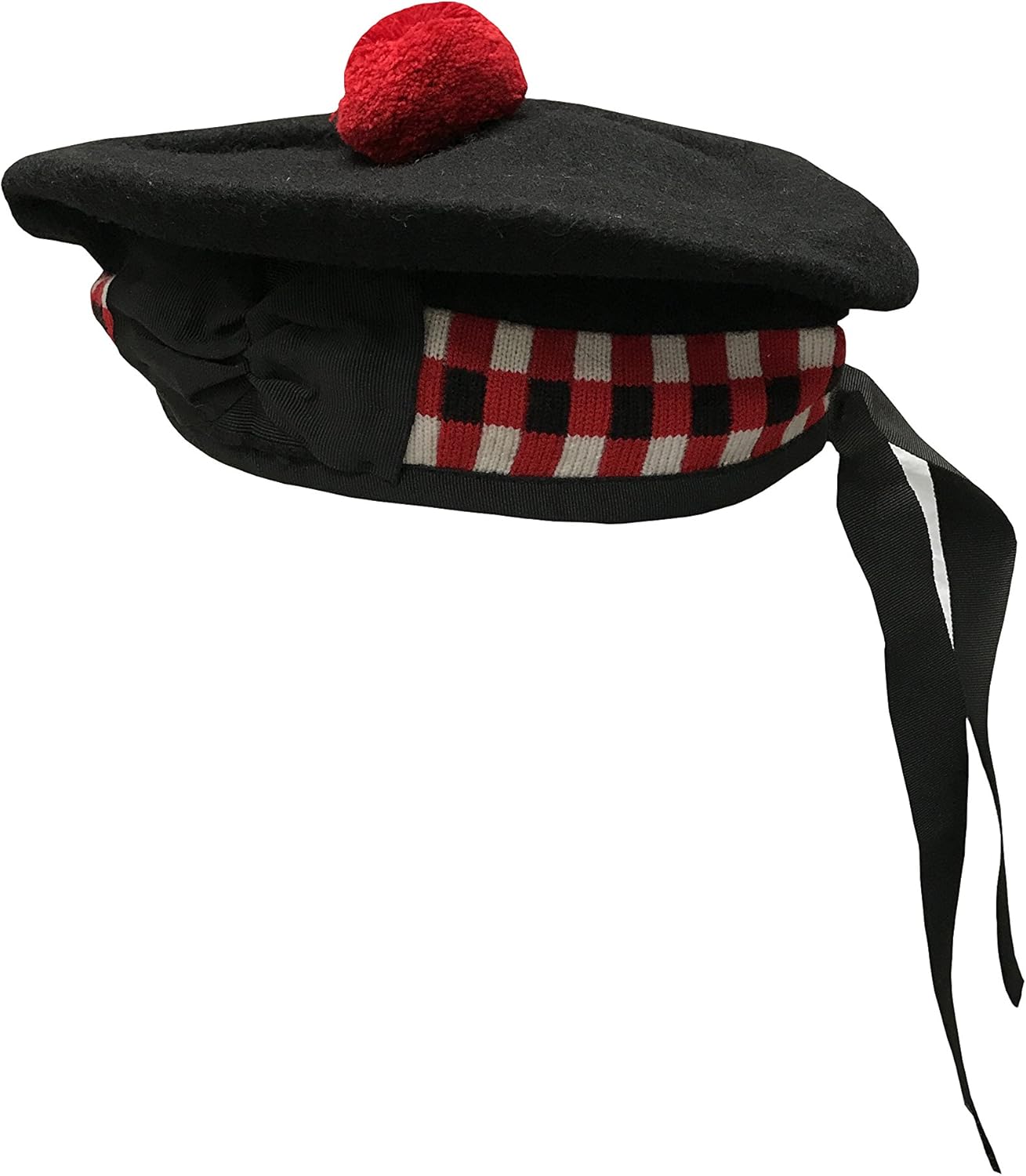
There is also the Balmoral cap, named after Balmoral Castle, a royal residence in Scotland, which is more of a beret with a small pom-pom on top, not so different from the styling of the original Scottish bonnet. In 1857 the Indian regiments also adopted the Kilmarnock cap.. The "classic quality wool Scottish Glengarries, Balmorals, Kilmarnock
bonnets and Tweed Tam O Shanters have been made here in Scotland since
1845 by Robert Mackie" says 'The House of Labhran' in the Scottish Highlands.
Subscribe to:
Posts (Atom)